Why Choose Leg Encircling Crane with Dual Hook Design
When offshore wind turbines grow beyond 15MW, the installation vessel's crane becomes the single most consequential piece of equipment on the project. A leg encircling crane — mounted concentrically around a jack-up leg — resolves the deck-space and load-moment challenges that conventional pedestal cranes cannot. The dual hook configuration takes this further by enabling simultaneous or tandem heavy lifts, distributing stress across two load paths, and sustaining operations even when one hook requires inspection. For Wind Turbine Installation Vessel (WTIV) owners and project directors benchmarking capital expenditure, the leg encircling crane with dual hook design is no longer an option — it is the engineering baseline.
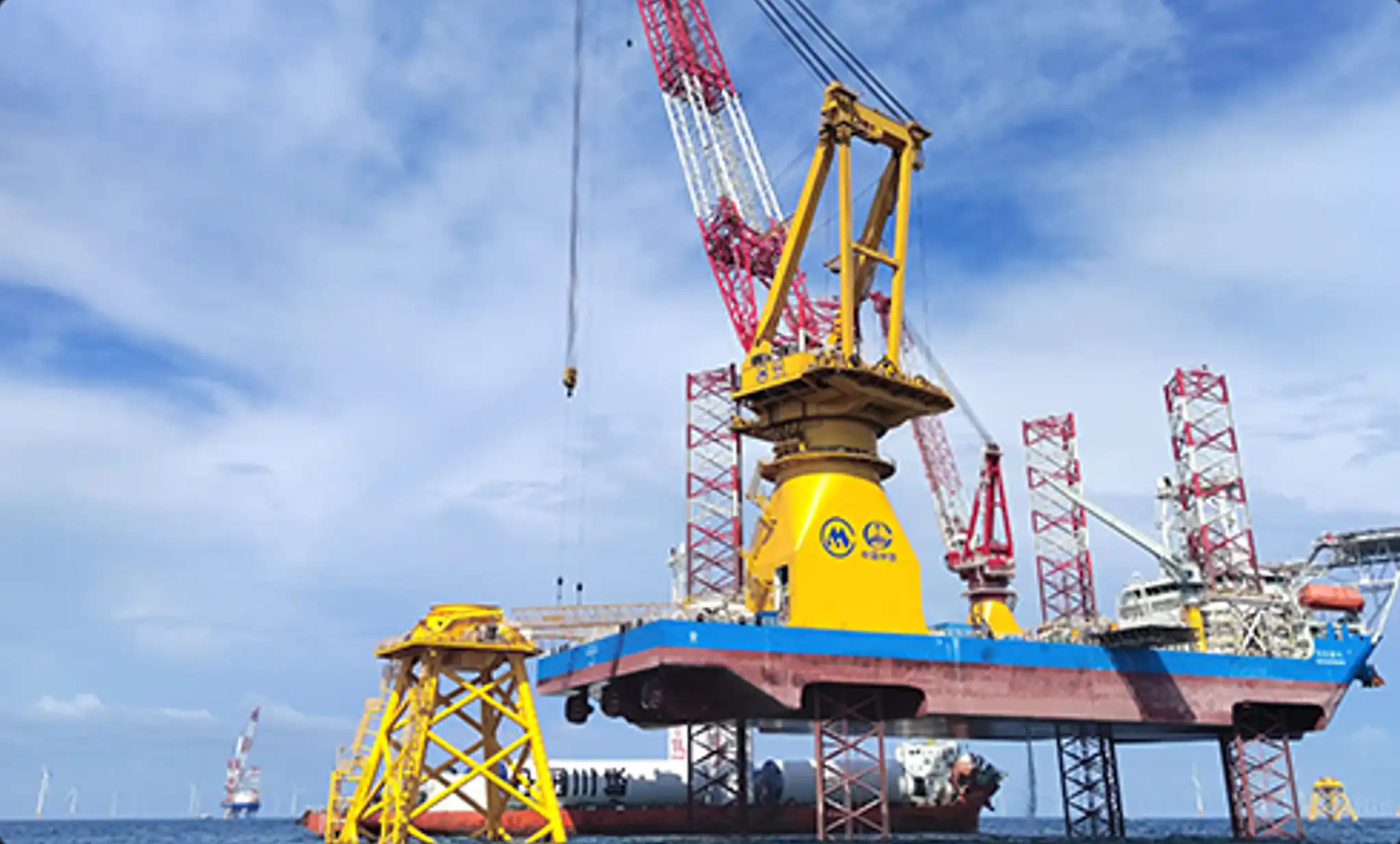
Understanding Leg Encircling Cranes and the Dual Hook Innovation
What Sets a Leg Encircling Crane Apart
The slewing platform of a Leg Encircling Crane is built right around the WTIV's lattice or tubular raising leg. The load moment is transferred neatly into the hull because the crane's structural tub is attached to the ship's strongest vertical part. This means that pedestal-mounted options don't have to deal with the awkward bending that comes with eccentric loads. This design also keeps the tail swing radius small, which keeps deck space for storing engine parts. During jacking operations, the vertical leg goes through the hollow middle of the crane. To keep the system from getting in the way, it is locked in a certain transit position.
How the Dual Hook Configuration Redefines Heavy Lifting
Traditional offshore cranes have only one main hoist, which means there is only one place where something could go wrong during important mating operations. This is taken care of by the dual hook system, which gives the same boom two separate load routes. When pulling a very heavy nacelle or tower piece, both hooks share the load evenly, which lowers the stress on the wire rope and boom chord. The second hook system keeps operations going even if the first one goes into maintenance. This is called redundancy architecture, and it directly protects installation windows and charter revenue.
TSC is a brand of CM Energy, which is listed on the Hong Kong Stock Exchange. It uses this dual hook principle in its largest Leg Encircling Crane models, which combine a stronger boom chord geometry, an intelligent load-monitoring control system, and electric automatic centralized lubrication into a single platform that works well together.
Advantages of Dual Hook Leg Encircling Cranes for Construction and Heavy Lifting
Operational Continuity, Structural Longevity, and Financial Bankability
As the size of the rotor gets bigger, the performance gap between a dual hook Leg Encircling Crane and regular offshore cranes gets bigger. Here are the main benefits that procurement chiefs always list:
- Operational redundancy: Since there are two separate main hooks, one can stay in use while the other is being loaded or a part is being replaced. This continuity directly stops expensive weather window loses during operations at sea.
- Symmetrical load distribution: Spreading an extremely heavy lift across two hooks lowers the peak bending moment at the boom foot, which increases the structural wear life and shortens the time between inspections.
- Intelligent risk prediction: During heavy-load operations, TSC's own control system for the Leg Encircling Crane checks the stress on the structure in real time and sends out predictive alerts before load limits are reached. This gives the lift supervisor useful information instead of reactive alarms.
- Wire tensioning and cargo stabilization: An integrated tensioning system stops the pendulum from moving during lifts, which is very important when placing nacelles at very high hook heights in open sea.
- High-end drivetrain components: High-end drivetrain parts, such as variable frequency drives, certified wire ropes, and redundant slip rings, keep the speed precisely controlled across the entire lift range. This lowers the shock load on both the crane structure and the lifted part.
All of these features work together to cut down on idle time, increase the time between machine maintenance visits, and protect the vessel owner's day-rate profits over a longer period of time. The dual hook Leg Encircling Crane has built-in redundancy, which means there is less technical risk in the credit model for lending institutions that are deciding whether an asset is bankable.
Comparing Leg Encircling Cranes with Other Crane Types
Design Trade-Offs and Mission-Specific Advantages
Pedestal cranes, shear-leg floating cranes, and Leg Encircling Cranes are the three main types of offshore heavy-lift options. Each one fills a different operating need.
Pedestal cranes are easy to install on the hull of almost any ship, but as the lift weight goes up, their mounting geometry puts a lot of stress on the deck structure. Shear-leg cranes have a very high standing capacity, but they can't slew all the way around, and each move needs to be done with great accuracy. Neither configuration can handle the very high hook height, very large radius, and open deck area that is needed for next-generation turbine installation.
All three problems are solved at the same time by the Leg Encircling Crane. Its concentric mount makes good use of the leg as a structural strongpoint, its slewing platform turns continuously without getting in the way of tail swing, and its boom shape allows hub heights that are higher than what most boom designs can handle. The Leg Encircling Crane is the only design that can do both tasks without having to switch out equipment. This is because it can turn XL monopile foundations upside down and then place 15MW+ turbine assemblies on the same vessel.
TSC tests its Leg Encircling Crane designs against the rules set by classification societies like CCS, DNV, ABS, BV, and LR. These societies represent all the flag-state registries that Chinese, European, and Southeast Asian WTIV operators use.
Procurement Guide: Buying a Leg Encircling Crane with Dual Hook Design
Long-Term Investment Criteria and Supply Chain Assurance
Buying a Leg Encircling Crane at this capacity level is usually a choice that takes a few years, from designing the idea of the ship to getting it approved by the factory and then starting it up on board. The following rating factors are always at the top of the list for procurement teams:
Vessel integration compatibility. From the very beginning of the design process, the shipyard's leg well detail must be taken into account when designing the crane tub geometry, bogie rail dimensions, and structural interface. Late-stage modification on this scale is too expensive and can't be done on time.
Classification society certification package for the Leg Encircling Crane. For accepting the ship as delivered and getting insurance, you must have a full certification file that includes structural analysis reports, welding procedure qualifications from a DNV- and BV-certified welding plant, load test records, and the Rated Capacity Limiter calibration data.
Supply chain depth for critical components. Wire ropes, slewing bogies, variable frequency drives, and hydraulic accumulators must all come from approved second-source providers and have written lead-time commitments. Dependence on a single source for any long-lead item makes the plan vulnerable, which leads to supply delays.
After-sales and spares support. Because a Leg Encircling Crane works in environments with C5-M corrosion and is loaded and unloaded dynamically with each lift, it is necessary to have access to OEM technical support, on-site commissioning engineers, and a dedicated spare-parts inventory. These are not extras that can be bought.
TSC's installation process includes analyzing customer needs, putting together the parts in the plant, testing the finished product, delivering it to the customer, and installing it on board. This gives procurement teams a single person to hold responsible throughout the whole delivery process.
How to Maximize the Value of Your Dual Hook Leg Encircling Crane
Proactive Asset Management and Operator Competency Development
At this investment level, a Leg Encircling Crane rewards operators who see asset management as an ongoing task rather than something that needs to be taken care of after the fact. Maintaining structured maintenance that is in line with the manufacturer's inspection schedules for things like lubrication cycles, wire rope retirement criteria, and tracking the state of bogie wheels helps keep the structure's certification status and stops the kind of unplanned downtime that lowers its annual utilization.
Training for operators is just as important. TSC's Leg Encircling Crane has an intelligent control system that sends real-time stress telemetry. However, lift supervisors need to know how to read load margin indicators and change the rigging geometry to get the most out of that data. Classification societies, like DNV, put out guidelines on what offshore crane workers need to know and be able to do. Aligning internal training programs with these guidelines lowers the risk of accidents and makes third-party checks easier.
Smart technology integration, such as Internet of Things (IoT)-enabled condition monitoring and predictive maintenance scheduling, increases the time between planned dry-dock inspections. This increases the asset's annual utilization rates and protects its value on the charter market.
Conclusion
The Leg Encircling Crane with dual hook design is the best WTIV lifting system right now in terms of performance. Its concentric mounting, ability to go to very high hook heights, and alternative load path design all work around the three issues that decide whether a ship can compete for contracts to install next-generation turbines: deck room, lift height, and operational continuity. This is possible with CM Energy's TSC brand because it has verified manufacturing credentials, multi-society classification certification, and a structured delivery process that lowers the risk of integration. When project leaders make a financial commitment at this level, the technical depth and execution responsibility are just as important as the crane's stated capacity.
FAQ
1. What is a leg encircling crane, and why is it used on WTIVs?
A Leg Encircling Crane attaches its slewing platform around the jacking leg of a jack-up vessel and uses the leg as a strong point for the structure. This design minimizes tail swing, increases free deck space, and allows for the very high hook heights needed for installing modern offshore wind turbines.
2. Why does the dual hook configuration matter for offshore wind installation?
Load redundancy is provided by two separate hooks; if one hook needs repair, work can still be done on the second. When lifting very heavy things, both hooks share the load evenly. This lowers the peak stress on the structure and increases the life of the boom's fatigue.
3. How does TSC certify its leg encircling cranes?
TSC gets approval for its Leg Encircling Crane models from a number of classification societies, such as CCS, DNV, ABS, BV, and LR. The cranes are also made in DNV- and BV-approved welding companies that follow an ISO quality management system.
Partner with CM Energy for Your Next Leg Encircling Crane Project
CM Energy's TSC brand is a well-known manufacturer of Leg Encircling Cranes. It has credentials from classification societies like CCS, DNV, ABS, BV, and LR, and more than 350 deck cranes are currently in use around the world. Whether you need a Leg Encircling Crane for a new WTIV build or want to improve an old platform, our engineering team can make solutions that fit your needs and provide full support throughout their lifecycle. To start your technical conversation, email us at info.cn@cm-energy.com or visit cm-energy.com.
References
1. DNV GL. DNV-ST-0378: Standard for Offshore and Platform Lifting Appliances. DNV, 2021.
2. American Bureau of Shipping. ABS Guide for Certification of Lifting Appliances. ABS, 2022.
3. Bureau Veritas. NR 526: Rules for the Certification of Lifting Appliances Onboard Ships and Offshore Units. Bureau Veritas, 2020.
4. International Renewable Energy Agency (IRENA). Offshore Wind Outlook 2023: Scaling Up for the Energy Transition. IRENA, 2023.
5. Wind Europe. Offshore Wind in Europe: Key Trends and Statistics 2023. Wind Europe, 2024.
6. China Classification Society. Guidelines for Classification of Offshore Wind Turbine Installation Vessels. CCS, 2022.