Slew-bearing Crane-wire Rope Luffing Crane Design Benefits
Superior structural efficiency, operational dependability, and servicing accessibility are the major design advantages of Slew-bearing Crane-wire Rope Luffing Crane. These machines use multi-reeve wire rope luffing systems and large-diameter slewing bearings to allow for accurate boom control and movement in all directions. The combination stops the hydraulic fluid leakage that happens with cylinder-based designs and provides better load distribution, longer reach, and visual inspection—all of which are important for offshore wind installations, FPSO operations, bulk carriers, and shipyard assembly areas where safety and uptime are key to making money.
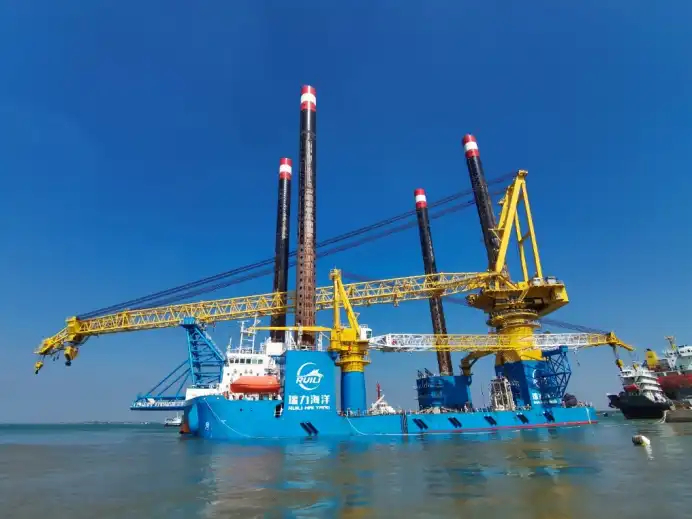
Understanding Slew Bearings and Wire Rope Systems in Luffing Cranes
What Makes Slew Bearings Essential for Rotational Stability?
Modern luffing cranes are built on slew bearings, which allow them to move smoothly in all directions, even when they are under heavy axial and radial loads. Unlike regular ring gears, slew bearings have inner and outer rings that are made up of precision-engineered moving elements like balls, rollers, or cross-rollers that spread the weight evenly across the mounting interface. This design lowers stress concentrations, which is very important when working with turbine parts on offshore wind farms or moving big equipment under the water on FPSOs. TSC uses high-strength metals to make three-row roller and double-row ball configurations that last as long as possible in marine settings.
Different types of bearings are used for different tasks. Ball bearings work great in situations where a high rotational speed is needed with mild loads. This makes them a good choice for offshore support boats that need to slew quickly. Roller bearings can handle heavier loads at slower speeds. This makes them perfect for removing aggregate from bulk ships or lifting hull sections on port assembly lines. Cross-roller bearings are the best combination of being small and strong, which means they can be used on drilling ships with limited room. Segmented bearings make it possible to change individual parts in the field, which cuts down on downtime during maintenance on remote installations.
How Wire Rope Systems Deliver Precision and Durability
Multi-layer reeving increases lifting power and maintains boom angle in wire rope luffing systems. These devices employ high-tensile steel ropes. They are robust and flexible because several strands are twisted around a steel or fibre core. When operating in seawater near LNG tankers or during deep-sea rescue operations, rope diameter, lay pattern, and galvanisation affect bending stress and corrosion resistance.
To uniformly spool rope and prevent bird trapping, reeving systems employ winch drums with Lebus grooves. Fleet angle compensators lessen sheave side loading by directing the rope. This extends rope life to over 10,000 cycles with appropriate management. Wire ropes show wear like broken wires, decreased diameter, and corrosion pitting, unlike sealed hydraulic tanks. This transparency aids scheduled repair, reducing VLCC tanker and port tugboat failures during critical lifts.
TSC of Slew-bearing Crane-wire Rope Luffing Crane keeps the rope supple and reduces friction using centralised cleaning systems that may be set up manually or automatically. Automatic lubrication schedules extend rope service intervals and avoid premature breakage due to improper grease application. Because wire rope systems are flexible, they may be changed without disassembling the boom. This is distinct from changing hydraulic cylinder seals, which normally requires a crane shutdown.
Design Benefits of Integrating Slew-Bearing and Wire Rope in Luffing Cranes
Enhanced Load Distribution and Structural Efficiency
When slew-bearing pedestals and wire rope luffing are used, the crane mounting platform is loaded evenly. Slew bearings distribute rotating forces across large contacts. This reduces point loads that might damage the jack-up or semi-submersible deck plate. This pressure distribution makes structural sections lighter and more rigid. The construction has the best weight-to-capacity ratio in its class, claims TSC. This efficiency benefits offshore wind turbine installers since less weight on the ship makes it more stable while transferring turbine components in severe seas.
Wire rope luffing methods eliminate the need for large hydraulic cylinders to move the boom, making structures more efficient. Triangular rope-guided luffing has a mechanical edge; fewer winches and motors are required for the same lifting moments. This compact design opens up deck space on platform supply boats and emergency response systems for goods or equipment. The crane's center of gravity is lower with fewer pieces, making it more stable during strong pulls on floating production storage offloading units.
Superior Rotational Precision and Operational Smoothness
Separate hydraulic circuits for each function provide slew-bearing cranes with the most exact turning precision. TSC design ensures safe and dependable multifunctional operation. This allows workers to slew, luff, and hoist simultaneously without hydraulic flow issues. Quick boom adjustment between hold doors speeds up bulk truck loading of grains or minerals. Precision-ground bearing raceways decrease load sway by smoothing rotation. This is crucial for transporting fragile equipment on drilling ships or underwater infrastructure near FPSO moonpools.
With variable-speed winch motors and load moment indicators, wire rope devices can accurately adjust boom angle. Workers may feel the load shifting due to rope tension. This makes low-vision and blind lift operations safer. TSC designs include emergency crane operating systems that enable complete operation if the prime mover or hydraulic pump fails. This ensures safe lifts during maritime crises or overseas building delays.
Extended Service Life and Reduced Maintenance Burden
Both parts and system design increase durability. High-quality API-2C slewing bearings may last over 15 years if properly maintained, outlasting alternative solutions for the same duty cycles. Wire rope systems are disposable yet beneficial for eye checks that prevent major issues. ISO 4309 compliance governs TSC's discard criteria, which require wire replacement when breakage, corrosion, or diameter loss reach 7% of its theoretical value. Standardised replacement planning makes it easier for procurement teams to prepare for port service boats and dock crane fleets.
Maintenance expenses are cheap since any portion may be replaced without replacing the complete system. Slewing bearings are greased by automated centralised systems, reducing human effort on distant offshore locations. Shipboard personnel can replace wire rope using normal rigging gear, saving money on crane repair visits to the shore. TSC's modular architecture with common parts reduces maintenance even further. This keeps LNG ship deck operations running smoothly and reduces crane downtime and revenue loss.
Best Practices for Maintaining Slew Bearings and Wire Ropes in Luffing Cranes
Establishing Effective Inspection Protocols
Proactive maintenance of Slew-bearing Crane-wire Rope Luffing Crane begins with structured inspection programs tailored to activity and environmental exposure. Slewing bearings must be rocked and evaluated for axial clearance every three months to detect raceway wear before it impairs performance. Ultrasound testing of mounting nuts annually detects hidden stress fractures. Weekly visual inspections of wire ropes are required during peak periods. Report broken wires, kinking, and surface corrosion using standard forms. Magnetic particle screening detects subsurface faults in welded structures on boom attachment locations before they become severe issues.
Inspection checklists should examine lubrication and bearing raceway grease contamination or thin films. Check pressure rollers and sheave grooves for unusual wear patterns that may indicate a misaligned reeving system. Fleet angle readings demonstrate that wire rope strikes sheaves at the ideal angles, preventing outer strand damage. Laser measuring instruments are used for alignment tests to ensure the fitting flange is level, since variances cause bearing distortion and decrease part life. These structured approaches prevent unanticipated issues on offshore support boats or heavy-lift barges erecting bridges.
Implementing Lubrication and Wear Management Strategies
The correct lubricants may extend tool life and reduce hydraulic power-wasting friction. Slewing bearing raceways and rope contact points are greased automatically by TSC's centralised greasing systems. This reduces application frequency errors. Electric lubrication systems allow you to choose the interval between lubrications, making them ideal for unmanned installations on distant locations that are hard to repair. Specialist wire rope lubricants include rust inhibitors and penetrating chemicals that reach the core strands and maintain ropes' suppleness even when bent repeatedly during luffing.
Early wear detection helps you correct issues before they grow worse. Wire rope diameter measurements at many locations throughout busy portions reveal worn patches due by misaligned or overloaded sheaves. Corrosion pitting depth helps determine service life. This is crucial in saltwater locations near LNG terminals or offshore drilling. Rocking tests illustrate how slewing bearings wear out. This helps you plan replacements and prevent crises at busy periods. Written maintenance records indicate to classification groups that an activity may remain certified.
How to Choose the Best Slew Bearing and Wire Rope for Your Luffing Crane
Evaluating Load Capacity and Operational Requirements
Complete a load study of static working loads, dynamic shock factors, and wind loads during operation and storms to determine the proper pieces. Check the manufacturer's load tables to ensure slewing bearings can take axial, radial, and moment loads. Semi-submersible platforms experience larger dynamic loads than stationary configurations. Bearings require larger safety margins. Your wire rope choice depends on its strength, bending fatigue over sheaves, and wear and tear. Bulk carrier operations that lift thousands of times a year require different rope-construction cranes than dock assembly cranes that lift a few times.
Rotational precision criteria influence bearing type. Cross-roller bearings can manage tight radial and axial runout tolerances for precision offshore wind turbine part placement. Roller bearing designs are cheaper because multifunctional boats can handle greater positional shift for general items. Flange flatness and bolt circle compatibility are crucial for crane frame and bearing mounting surface fit. Procurement teams should match dimensional plans to installation interfaces to minimise costly field adjustments during retrofits or upgrades.
Assessing Supplier Reliability and Certification
Supplier reputation affects equipment reliability and service support. Long-standing manufacturers with DNV, ABS, BV, CCS, and LR certifications fulfil demanding maritime equipment requirements. These certifications verify offshore welding, material traceability, and quality management. Lead times influence project timetables, particularly when modernising ships or constructing new platforms with constrained delivery dates. Manufacturers using conventional component supplies may produce faster than entirely tailored designs.
Cost efficiency of Slew-bearing Crane-wire Rope Luffing Crane involves spare component availability, expert assistance timeliness, and guarantee duration, as well as product pricing. Tensile strength certifications and mechanical studies from wire rope suppliers reassure consumers of the material's quality. Slewing bearing manufacturers that provide field service for installation assistance and approval reduce the danger of improper mounting, which may void warranties. International offshore operations need support infrastructure like TSC's worldwide service network. It offers professional guidance and speedy parts to keep operations running smoothly.
Procurement Insights: Buying Guide and Market Overview for Slew Bearings and Wire Ropes
Identifying Qualified Suppliers and Custom Solutions
Successful procurement strategies meet business and technological demands. You may find marine crane part manufacturers by searching the internet supplier lists and industry associations. Bulk orders may save money when equipping numerous ships or standardising fleet equipment. Custom engineering is needed for unique applications like FPSO turret cranes and salvage boats. Suppliers frequently find better solutions for particular operational profiles when they work together during planning.
Costs depend on material grades, manufacturing complexity, and licensing regulations. Slewing bearings made of high-strength metal steels cost more but survive longer in demanding conditions. Wire rope prices vary by building type, galvanisation, and diameter. Certification by a classification organization increases engineering research costs, yet international maritime law requires it for marine locations. Fast manufacturing production determines delivery times. Special forgings might take months, while standard sizes ship in weeks. For budget approval and lifetime cost analysis, procurement managers should get estimates that break down materials, manufacturing, testing, and certification costs.
In the worldwide maritime equipment sector, CM Energy (TSC) has extensive expertise. Over 180 jack-up platforms and 350 deck cranes worldwide employ its lifting equipment. Our manufacturing capabilities include ISO quality standards, DNV-certified welding facilities, and all major classification society certifications. Customisable wire rope luffing cranes are available for stationary platforms, drilling vessels, and ocean locations. API-2C accreditation, coupled with electrical control systems with load management and dedicated hydraulic circuits, demonstrates our safety and reliability. Flexible design and standard parts provide fast delivery without sacrificing quality, helping customers meet project deadlines.
Conclusion
When procurement teams choose equipment based on its technical value, the name of the seller, and the availability of a full support system, they set up their operations to continue performing at a high level. The Slew-bearing Crane-wire Rope Luffing Crane exemplifies this principle: it integrates the precise slewing bearing and robust wire rope luffing mechanism into a single, proven package. As the marine industry continues to change and face more difficult lifting problems, tried-and-true designs that combine simple mechanics with efficient structure—such as the Slew-bearing Crane-wire Rope Luffing Crane—will still be the key to completing projects successfully.
FAQ
1. How often should slewing bearings be inspected on wire rope luffing cranes?
How often you inspect relies on how busy your business is and how exposed you are to the surroundings. Active marine sites should test the axial clearance with shaking tests every three months and the mounting bolts with ultrasonic tests once a year. The slewing ring and wire rope systems should be visually checked once a week while they are in use, and they should be thoroughly checked after big lift campaigns or storms. Equipment used in saltwater settings needs to be inspected more often than equipment used on dry waterways. Maintenance records that show you followed the manufacturer's instructions help with insurance and classification society checks.
2. What advantages do wire rope systems offer over hydraulic cylinder luffing?
In contrast to sealed hydraulic cylinders, which need to be taken apart for an internal examination, wire rope luffing systems can be inspected visually, so wear can be found before it causes failure. During high-duty cycles, operational costs stay low because replacing the rope costs less than fixing the hydraulic seals and cleaning up fluid leakage. Because wire rope systems are mechanically simple, they have fewer places where they can go wrong. This makes them more reliable during long campaigns abroad, where it can be hard to get repairs. When the hydraulic pump fails, emergency operating systems can keep the crane working, which is very important for maritime emergency reaction and offshore building safety.
3. How can I be sure that the wire ropes I'm using will work in my situation?
When choosing wire rope, you should follow the ISO 4309 rules that say to match the breaking strength to the highest working loads with the right safety factors, which are usually 5:1 for lifting activities at sea. Different types of construction affect how well a rope resists bending stress. For example, rotation-resistant ropes work best for lifting single parts, while standard lay ropes work best for reeving multiple parts over sheaves. In naval settings, galvanisation stops corrosion, and for bulk handling, speciality coatings make things less likely to wear down. Supplier-provided papers that prove the makeup of the material, the results of tensile tests, and production standards give a guarantee of quality and regulatory compliance, which is necessary for classification society approval.
Maximize Your Crane Performance with Expert Solutions from CM Energy
To choose the best Slew-bearing Crane-wire Rope Luffing Crane manufacturer, you need to look at both their professional skills and their help network. As shown by the fact that we have installed more than 350 deck cranes and other equipment on more than 180 self-elevating platforms around the world, CM Energy is a technology-driven company with a lot of experience in marine energy solutions. Our TSC-branded wire rope luffing cranes have value-engineered frames that make them more rigid while also making them lighter. They are API-2C certified and have been approved by all major classification societies, such as DNV, ABS, BV, CCS, and LR. Full factory acceptance testing, on-board installation support, and integrated electricity control systems with load management make sure that your equipment works safely and efficiently from the time it is first set up until it is retired after many years of use. Email our team at info.cn@cm-energy.com to talk about custom solutions that are made to fit your specific operational needs and to get full technical specs that will help you make decisions about what to buy.
References
1. American Petroleum Institute. (2018). Specification for Offshore Pedestal Mounted Cranes (API 2C). Washington, DC: API Publishing Services.
2. International Organization for Standardization. (2017). Wire Rope—Care and Maintenance, Inspection and Discard (ISO 4309:2017). Geneva: ISO Central Secretariat.
3. Det Norske Veritas. (2020). Classification Note 61.3: Certification of Offshore and Platform Lifting Appliances. Oslo: DNV GL Group.
4. Bureau Veritas Marine & Offshore. (2019). Rules for the Classification of Offshore Units: Part D, Chapter 5 Cranes and Lifting Appliances. Paris: Bureau Veritas.
5. Lloyd's Register. (2021). ShipRight Design and Construction: Lifting Appliances—Procedure for Additional Design Assessment. London: Lloyd's Register Group.
6. American Bureau of Shipping. (2022). Guide for the Certification of Offshore Mooring Chain and Wire Rope. Houston: ABS Technical Publications.