Know your wind assisted propulsion systems
A wind assisted propulsion system (WAPS) is an auxiliary technology that uses aerodynamic forces to generate thrust alongside a vessel's main engine. Rather than replacing conventional propulsion, it works in parallel to reduce fuel consumption and carbon emissions. For bulk carrier and tanker operators facing IMO EEXI, CII, and EU ETS compliance deadlines, understanding how a wind assisted propulsion system works — and which solution fits your fleet — is the first step toward smarter capital investment and measurable operational savings.
Understanding Wind Assisted Propulsion Systems
What a Wind Assisted Propulsion System Actually Does
A ship with a wind-assisted propulsion system can't move itself. It turns wind energy into forward thrust using stiff wings, rotor sails, or kite-like structures. This directly lowers the load on the main engine. If the trade winds are steady during a trans-oceanic trip, this smaller load immediately means less fuel burned each day.
The Core Technology Categories
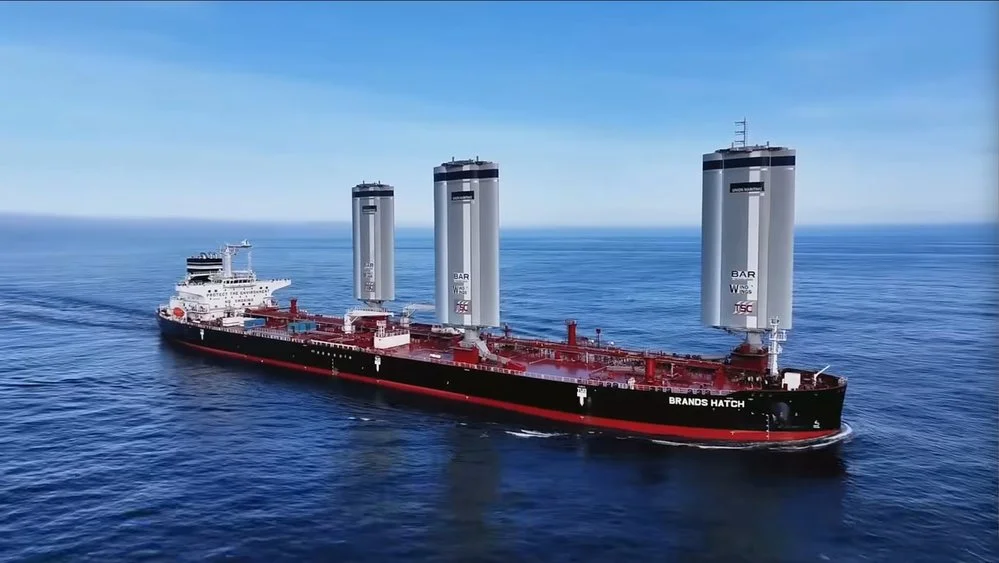
Today, rigid wing sails, Flettner rotors, and towing kites are the three most common types used in commercial shipping. Rigid wing sails, which is what TSC's WindWings® product is, create lift in the air like an airplane wing. Their camber and angle of attack can be changed completely, which lets them be optimized in real time as the wind changes during a voyage.
Why Fleet Operators Are Paying Attention Now
The main cause is regulatory pressure. The IMO's Carbon Intensity Indicator framework says that existing ships must show CII improvement from one year to the next. The EU Emissions Trading System charges trips a direct carbon cost. According to IMO MEPC.1/Circ.896, a wind assisted propulsion system is a Category B innovative energy efficiency technology that directly adds to EEXI and CII formulas. This means that it is both a compliance tool and a fuel-saving device.
Comparing Wind Assisted Propulsion With Traditional Propulsion Systems
The Cost Exposure of Diesel-Only Operation
Changes in the price of bunker fuel can affect ships that only use conventional engines. VLSFO prices were above $600 per metric ton in 2023 at all big bunkering hubs. A Capesize bulk carrier that burns 50–60 tons of fuel every day would save hundreds of thousands of dollars a year with even a 10% fuel reduction from a wind-assisted propulsion system.
Retrofit vs. New Build: Which Route Fits Your Fleet?
Technically, both paths can be taken. For retrofit installs, you need to do a structural compatibility study, a stability review according to IMO weather criteria, and work with the dry-docking windows. With new-build integration, the system can be built into the ship from the very bottom up, which makes base building easier. A wind-assisted propulsion system from TSC is designed to fit between the cargo holds of both ships. It has a fold-down feature that makes room for hatch covers and cargo gear, which is something that many fleet managers say is necessary before the system can be used.
Solar and Hybrid Systems in Context
Solar panels and battery hybrid systems are good ways to recover energy, but they can't make as much push as a wind-assisted propulsion system can on ocean trips. On routes with steady wind patterns, like the iron ore trade between Brazil and China or the grain routes in the North Atlantic, wind energy density per square meter of sail area is much higher than what solar panels can provide on the same deck space. Still, solar and wind technologies don't have to be used together; in fact, forward-looking plans to decarbonize fleets often combine more than one solution.
Key Technologies and Leading Brands in the Market
Rigid Wing Sail Systems: TSC WindWings®
CM Energy's technology brand, TSC, sells WindWings®, a three-element rigid wing sail that was made in collaboration with BART Technologies (BART) in the UK. The three-element airfoil shape of the system is trademarked and gives it more than 2.5 times the aerodynamic lift of a normal single-wing sail. Wolfson Unit and Lloyd's have separately checked the performance, and DNV has approved it. Type approval and AIP certification from DNV and BV show that the structure and operation meet the needs of the classification society.
WindWings® comes in three span sizes: 20m, 24m, and 37.5m. These sizes cover a wide range of ship types, from small bulk carriers to big tankers. The 37.5m model has a wing area of 754 m² per unit and has been shown to save 1.6 tons of fuel per day per wing, which means 5.12 tons of CO₂ per day per wing. These numbers were proven by boat operations in the real world and DNV-verified sea trial data, not just theory modeling.
There is a lot of information on operational dependability. Bulk carriers with TSC WindWings® have made calls at more than 20 major ports around the world without any problems. This data, which covers more than a year of commercial service, is something that fleet technical directors and ship classification engineers always ask for before committing to capital expenditure.
Procurement Guide: How to Buy and Implement Wind Assisted Propulsion Systems
Evaluating Suppliers: What Matters Most
When looking for a wind assisted propulsion system, procurement teams should focus on three things: performance data from real ships that have been checked, valid classification society certification across all important flag states, and a provider that can help with the whole process, from installation to upkeep. Type approvals for TSC's WindWings® come from DNV, LR, BV, and CCS. These are the four main classification societies that most foreign fleet owners work with. All of the materials come from sources that are ISO-certified, and the system is tested in the workshop before it is sent out.
These are the main things that expert fleet technical directors look at when choosing a supplier:
- Real-ship performance data: Ask for DNV-verified sea trial results instead of just CFD models. TSC's recorded port call record in more than 20 places around the world gives buying teams reference data that can be checked by anyone.
- Classification coverage: Make sure that the supplier has the right type approval for the flag state of your ship. DNV, BV, LR, and CCS have all given their approval to TSC's WindWings®.
- Operational footprint: Look at how the system affects the hatch cover and how cargo is moved. This is directly dealt with by TSC's fold-and-rotate laydown system, which keeps the crew's work from being interrupted.
- Lifecycle support: Check to see if the provider offers long-term repair contracts, IoT-based remote tracking, and weather route integration. All of these are done by TSC through an organized lifecycle care program.
These factors help procurement teams move quickly from expert qualification to business negotiation, which cuts down on the usual decision-making time of 6 to 18 months.
ROI Framework for Budget Approval
For board-level approval of capital expenditures, a model for estimating fuel savings should include data on the likelihood of wind along the route, current bunker prices, and the ship's current CII rating trajectory. A single TSC WindWings® unit on a ship operating in a moderate wind corridor can save 1.6 tons of fuel per day per wing, which brings the annual savings into a range where they can be compared to other ship efficiency investments. During the evaluation step, CM Energy's technical team can help with ROI research for each route.
Future Trends and Sustainability Outlook for Wind Assisted Propulsion
Regulation Will Drive Faster Adoption
According to the IMO's 2030 and 2050 GHG goals, the shipping sector needs to cut its carbon intensity by at least 40% by 2030 compared to 2008 levels. A wind-assisted propulsion system is the only type of auxiliary technology that has been tested on bulk ships and tankers on a business scale at this rate of adoption. Green lending institutions and POEL (Pool of Environmental Leaders) charterer programs are favoring more and more ships with certified wind power systems.
Digital Integration Is Becoming Standard
Installations of modern wind-assisted propulsion systems are no longer just mechanical improvements. TSC's WindWings® includes a web-based weather routing platform that can be used by both crew on board and teams working from shore, as well as automated workflow tools that can change the orientation of the wings in real time. At this level of digital integration, fleet managers can think of each wing as a data-generating asset that feeds into CII reporting tools and helps them plan future trips.
Long Asset Life Supports Long-Term Planning
A wind assisted propulsion system is an advantage for the fleet instead of an expense for a single vessel because it is designed to last for 25 years and can be moved from one vessel to another. This ability to be transferred is especially useful for fleet renewal programs, in which owners are getting rid of older trucks and putting in orders for new ones.
Conclusion
A wind-assisted propulsion system is now not just a cool new idea. It is a widely proven and classified tool for reducing carbon emissions in fleets that directly meets the needs of EEXI, CII, and EU ETS compliance. TSC's WindWings®, which was created with BART and approved by DNV, is one of the best-documented rigid-wing sail solutions for tanker and bulk ship owners right now. If fleet owners act quickly, they can get better access to green funding, lower fuel costs, and stronger relationships with charterers. The information is here. It is possible to get the certificates. You decide what to do next.
FAQ
1. What vessel types are best suited for a wind assisted propulsion system?
The best candidates are big bulk carriers and tankers with clear deck space between the cargo holds. TSC's WindWings® are designed to work with this type of vessel, with positioning that lets the hatch cover work and the cargo gear go without any problems.
2. How complex is retrofitting an existing vessel?
A hull compatibility study, structural strengthening at fixing points, a stability assessment, and planning around a planned dry-docking window are all things that need to be done for a retrofit to work. This process is run by TSC in five steps: compatibility analysis, on-site assembly, factory acceptance testing, delivery, and installation on board. Off-hire time is kept to a minimum by the process.
3. What maintenance does a rigid wing sail require?
The TSC WindWings® system has hydraulic and control parts that are made to withstand the harsh conditions of the sea. The work of the crew is like operating a deck crane; you don't need to know a lot about sails to do it. Standard 5-year dry-docking cycles are in line with condition-based repair intervals, and TSC offers long-term service plans with IoT tracking from afar.
4. How does a wind assisted propulsion system affect EEXI and CII calculations?
How does a wind-assisted propulsion system change the calculations for EEXI and CII? As per IMO MEPC.1/Circ.896, a wind-assisted propulsion system is a Category B new device for saving energy. The wind matrix method is used to figure out the wind power savings, which directly lower the vessel's EEXI number and raise its annual CII grade.
Connect With CM Energy — Your Wind Assisted Propulsion System Supplier
CM Energy and its TSC brand bring proven technical know-how to the process of decarbonizing fleets. Up to 30% less fuel is used with TSC WindWings®. It has certifications from DNV, BV, LR, and CCS, and comes with a full lifetime support package that includes IoT tracking and weather routing. For any route, our wind assisted propulsion system is ready to do a study for you, whether you are looking at a retrofit for your current fleet or planning a new build. To schedule a meeting, email us at info.cn@cm-energy.com or go to cm-energy.com.
References
1. International Maritime Organization. MEPC.1/Circ.896 — Guidelines on the Method of Calculation of the Attained Energy Efficiency Existing Ship Index (EEXI). IMO, 2021.
2. DNV. ST-0511: Sail Assisted Propulsion Systems — Class Guideline. DNV, 2022.
3. Wolfson Unit for Marine Technology and Industrial Aerodynamics. Aerodynamic Performance Assessment of Rigid Wing Sail Systems. University of Southampton, 2021.
4. Lloyd's Register. Wind-Assisted Ship Propulsion: Technology Assessment and Certification Framework. Lloyd's Register, 2022.
5. Bureau Veritas. NR 206: Rules on the Classification of Steel Ships — Supplementary Chapter on Wind Propulsion. Bureau Veritas, 2023.
6. International Windship Association (IWSA). Wind Propulsion Technology Roadmap for Commercial Shipping. IWSA, 2023.
