Automated Sail System vs Rotor Sail: Which Fits Your Ship?
If you manage a fleet of bulk carriers or tankers, you have probably heard a lot about wind-assisted propulsion lately. Two technologies dominate the conversation: the automated sail system and the rotor sail. Both use wind energy to cut fuel consumption and reduce emissions, but they work very differently. So which one actually fits your ship? This article breaks down both technologies clearly, so you can make a confident procurement decision backed by real data.
Understanding Automated Sail Systems and Rotor Sails
It is helpful to know what each technology does and how it got to where it is now before comparing how well it works.
What Is an Automated Sail System?
An automated sail system is a way to move with the help of the wind. It has rigid mechanical wing shapes and automated control software. Real-time wind data is sent from sensors to programmable logic controllers, which keep changing the sail angle and camber shape without anyone having to touch the deck. In other words, the system can adapt to new situations faster than any team member could. So, the push is always the same, even when the wind is blowing from different directions and the sea is rough.
What Is a Rotor Sail?
A rotor sail, which is sometimes called a Flettner rotor, works in a totally different way. The lift comes from the Magnus effect, which is the same physics that makes a curveball curve in baseball. To keep the cylinders moving on rotor sails, electric motors are needed. They are small and cylindrical, and more and more ships have them since Norsepower made the current form popular in 2014.
How Did We Get Here?
The idea of using wind to move things is not new, but the level of engineering precision we have now is very different. The first Flettner blades were put on cargo ships in the 1920s. Before they were used on commercial ships, rigid wing sails got a lot of attention in offshore yacht racing. When the IMO's Carbon Intensity Indicator (CII) rules went into effect in 2023, they pushed both technologies faster into the main buying plan.
Key Performance and Functional Comparison
Which method gives me better results for my specific ship type and trade route? That's the real question for any fleet technical director.
Thrust Generation and Fuel Savings
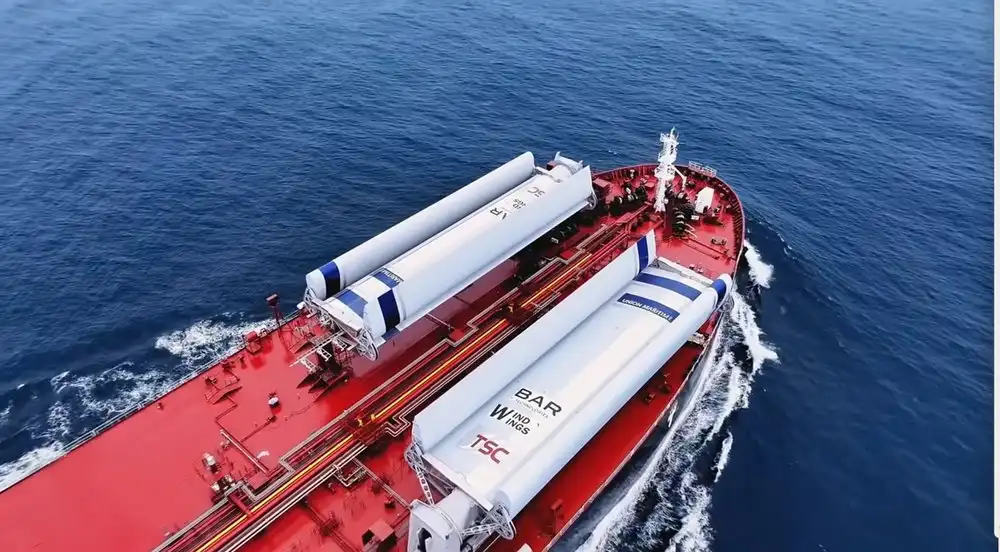
A three-element stiff wing design in a automated sail system can make more than 2.5 times as much lift as a normal single-wing sail. The TSC WindWings® from CM Energy were created in collaboration with BAR Technologies in the UK. On the 37.5m model, each wing saves up to 1.6 tons of fuel every day. That means that more than 5 tons of CO2 are saved every day per wing. DNV has independently checked these numbers by using real ships to do operations. Rotor sails can save between 5 and 10% of fuel per unit, but this depends on the wind conditions along the route.
Installation and Deck Compatibility
Rotor sails don't take up much space, so they work well on some types of boats. But bulk ships are really hard because hatch cover operations have to keep going even when there aren't any passengers on board. This is directly dealt with by the TSC automated sail system. Each wing can be rotated into a "laydown" position to make room for hatch covers and tools used to move goods. This means that it can be used in the same way as any other bulk carrier. This is an important operational benefit that can't be achieved with rotor sails.
Maintenance and Operational Complexity
Rotor sails have moving parts that keep turning quickly, which wears out bearings and motor parts. The TSC automated sail system works like a deck crane. You don't need to know anything special about ropes to use it, and the crew can control it with a familiar keyboard. IoT remote tracking and long-term service packages cut down on unplanned downtime even more.
Procurement Considerations for B2B Clients
When fleet owners look at wind power technology, getting it isn't always as easy as buying something. It's a big job that includes designing the ship, getting approval from the classification society, getting permission from the charterer, and training the crew.
Cost-Benefit Analysis
The initial cost of a automated sail system is high, but the payback is easy to see on routes that use a lot of fuel. The asset will be valuable in the future because it will save up to 30% on fuel on good lines and last for 25 years. You can also move TSC WindWings® from one ship to another. This protects your investment even if the make-up of your fleet changes. According to EU ETS and FuelEU Maritime rules, using less fuel also directly lowers carbon cost liabilities, which has an effect on your bottom line every trip.
Supplier Evaluation Criteria
When looking at any automated sail system provider, you have to make sure they are certified and have been tested in the real world. The TSC WindWings® has type approval and AIP certification from DNV and BV. LR and CCS also recognize it. Performance data has been confirmed by actual ship operations at more than 20 major ports around the world that went smoothly. All the materials come from sources that are ISO-certified, and the structure is designed to meet the standards for wear and cyclic loads set by the classification society.
Integration with Existing Systems
The automated sail system connects to weather routing software through a web-based interface that can be used by both teams on land and people on board. This means that your operations team can keep an eye on thrust performance and route improvement at all times. The system also has automated tools for work flow that work with other platforms for managing ships.
Advantages, Limitations, and Decision-Making Criteria
Every ship doesn't need the same kind of tech. Here is a fair evaluation to help you make your choice.
Where the Automated Sail System Excels
The TSC automated sail system works especially well for tankers and big ships that travel across oceans when there are steady trade winds. A three-element stiff wing pulls in a lot more air pressure per square meter than a rotor sail. Its folding and rotating mechanism gets rid of the problem of cargo operations getting in the way, which is one reason why many shipowners are hesitant to add deck-mounted power systems.
Practical Constraints to Acknowledge
For proper placement, a automated sail system needs enough deck length between the storage holds. The weight above must be taken into account in the ship's stability calculations, and the installation time must be coordinated with your dry docking plan. These are manageable engineering problems that need to be dealt with early on in the planning phase of the project, ideally when the feasibility and route analysis stage is being done.
Decision Framework
If your fleet runs bulk carriers or tankers on routes with strong beam or quarter winds, you want to save as much fuel as possible per wing, and you need a system that doesn't stop cargo operations, choose a automated sail system. The TSC WindWings® is the best choice for this type of vessel because it has the best aerodynamic performance, is certified by a classification society, and can be used in a variety of ways.
Future Trends and Technological Innovations
AI and IoT Integration
More AI is being built into the next version of automated sail system technology. IoT devices will collect real-time performance data that will be fed into prediction algorithms. These algorithms will change the wing angle and the route selection at the same time, making every trip more efficient.
Regulatory Drivers Through 2030
The IMO's 2030 and 2050 decarbonization goals, along with the EU ETS's growth to shipping and FuelEU Maritime's phased requirements, turn wind-assisted power from a way to save energy to a way to meet regulations. When fleet owners install a automated sail system, they are now building a track record of lowering carbon emissions that can be used to meet the needs of both green financing and charterer green rating.
Hybrid Propulsion Architecture
Some ship owners are looking into how wind power can be combined with ammonia or methanol engines. The automated sail system works with these bigger decarbonization plans because it's a separate source of power that doesn't depend on the main engine fuel.
Conclusion
Selecting the best wind-assisted propulsion system relies on the vessel type, its operating routes, deck layout and long-term efficiency objectives. Compared to rotor sail systems, an Automated Sail System provides a highly adaptable solution with automated control, good aerodynamic performance and flexible integration for big commercial vessels such as bulk carriers and tankers. CM Energy’s TSC WindWings® combines patented three-element rigid sail technology, strong certification from leading classification societies and proven operational validation to assist shipowners cut fuel consumption and emissions. CM Energy offers a trusted solution for fleets looking for pragmatic options for marine decarbonisation and future-proof energy management, including bespoke installation assistance, lifetime services and ongoing technological development.
FAQ
1. Can an Automated Sail System and a rotor sail be installed on the same vessel?
Technically, both can be fitted on the same ship. However, deck space is always limited on bulk carriers, and placing both systems requires careful structural and stability analysis. Most shipowners choose one technology based on their specific route profile and vessel dimensions rather than combining both.
2. How does the Automated Sail System perform in storm conditions?
The TSC Automated Sail System includes automated failsafe logic. When wind speeds exceed operational thresholds, the system immediately feathers the wing to align with the wind or stows it to the laydown position. This is a standard safety requirement under DNV WAPS guidelines, and it happens automatically without requiring crew action on deck.
3. What is a realistic payback period for retrofit projects?
Payback periods depend on your specific trade route, fuel price, and number of wings installed. Based on independently verified savings of up to 1.6 tonnes of fuel per wing per day, most operators on North Atlantic or Trans-Pacific routes target a payback window of three to seven years.
4. Does installation affect cargo capacity?
The TSC Automated Sail System is positioned between cargo holds and rotates clear of hatch covers during loading and discharge operations. Stability calculations are completed as part of the compatibility analysis to confirm that cargo loading is not restricted.
Talk to CM Energy About the Right Automated Sail System for Your Fleet
Based on 159 valid patents and DNV's real-world validation, CM Energy and its TSC brand have a good track record when it comes to marine energy solutions. As a reputable maker of automated sail system, TSC backs up the WindWings® with full lifetime support, from figuring out if they are compatible and installing them to keeping an eye on the Internet of Things and planning routes based on the weather. Talk to our team right away about your fleet's decarbonization plan. To set up a meeting, email us at info.cn@cm-energy.com or go to cm-energy.com.
References
1. International Maritime Organization (IMO). 2023 IMO Strategy on Reduction of GHG Emissions from Ships. IMO, 2023.
2. DNV. WAPS — Wind-Assisted Propulsion Systems: Rules and Standards. DNV, 2023.
3. Traut, M., et al. "Propulsive power contribution of a kite and a Flettner rotor on selected shipping routes." Applied Energy, 2014.
4. Norsepower. Rotor Sail Solution: Performance and Operational Data. Norsepower, 2022.
5. Lloyd's Register. Wind-Assisted Ship Propulsion: Technology Review and Approval Framework. Lloyd's Register, 2022.
6. Smith, T.W.P., et al. Third IMO GHG Study 2014. International Maritime Organization, 2014.