Why Knuckle Boom Cranes Are Essential in Offshore Oil Platforms?
When someone asks me why articulated lifting equipment matters so much on an offshore oil platform, my answer comes down to one thing: space is scarce, and the work never stops. A knuckle boom crane solves both problems at once. It can maneuver around obstructions, fold down when not in use, and take loads that a straight-arm crane just cannot handle in confined spaces because to its folding boom design. A knuckle boom crane provides the reach and control your deck crew need every shift, whether you run a drilling rig, an offshore support ship, or a multipurpose vessel.
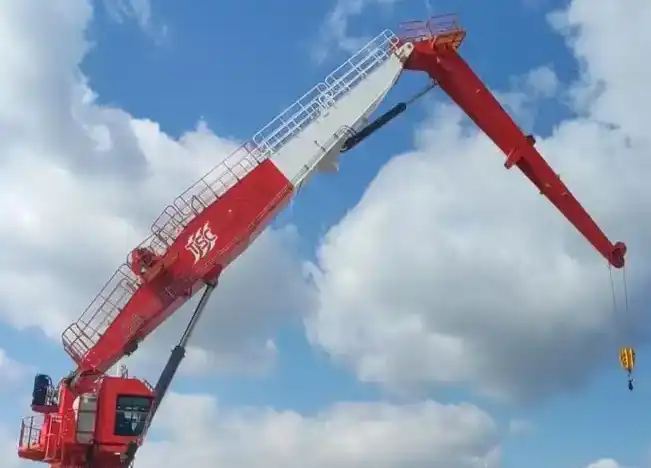
Understanding Knuckle Boom Cranes and Their Offshore Applications
What Makes the Boom "Knuckle"?
The knuckle, a hinged component that joins the inner and outer boom segments, is the source of the term. The arm may precisely stretch forward and backward or fold in half thanks to the hydraulic bending of that joint. In contrast to a fixed-boom crane, this flexible arm can either place a load right next to the column or stretch it out over the side of a ship. The Knuckle Boom Crane works really well on small work decks because of its shape.
Core Offshore Challenges This Design Addresses
Offshore platforms and service vessels are always under three pressures: limited deck space, platform movement caused by waves, and strict safety rules set by the classification society. Knuckle Boom Cranes take up less space on the deck than telescopic ones, fold up when not in use to keep walkways clear, and can be used with active wave compensation systems to keep loads under control when the seas are rough.
Where These Cranes Work on a Rig or Vessel
On an offshore oil platform, an articulated deck crane is used to transport supplies from support boats, position subsea equipment, and assist with high-altitude repairs. On offshore support ships and multipurpose ships, cargo is loaded and unloaded between the hull deck and a platform or dock. They are helpful every day and not just in emergency situations since they can reach up to the edge of a platform or into a ship's hold without requiring the whole crane to be moved.
Key Advantages of Knuckle Boom Cranes in Offshore Operations
When working with goods offshore, articulated lifting tools makes a real difference. Here are the main ways that this type of crane is better than other deck tools for work.
- Compact footprint with extended reach: The folding arm stores within a small deck area yet extends to cover a wide working radius. TSC models, for example, offer boom lengths suited to both light utility lifts and heavier general cargo work across different vessel sizes, without demanding oversized deck real estate.
- Precise load positioning: Step-less hydraulic controls let the operator move a load slowly and accurately, which matters when setting equipment on a platform grating or lowering supplies through a narrow hatch. This level of control is difficult to replicate with a conventional fixed-boom design.
- Integrated safety systems: Modern articulated cranes include load moment indicators, overload protection, and safety alarm systems that comply with API-2C, DNV, and BV standards. These features help operators stay within rated limits even when sea conditions push the vessel into unexpected motion.
- Multi-function simultaneous operation: The ability to run slewing, hooming, and extension movements at the same time shortens cycle times during vessel loading and unloading, reducing the time a support ship spends alongside a platform—a direct cost saving for offshore operators.
All of these benefits lower organizational risk and boost output on every shift. For small to medium-sized ship owners who have more than one charter contract, this difference in efficiency means a loss of competitive edge.
Operational Best Practices and Maintenance Tips for Offshore Use
Operator Certification and Training
Without a trained team, no piece of deck equipment will work as it should. People who drive flexible marine cranes should have up-to-date approval from a reputable organization like OPITO or a similar national authority. Crews learn how to handle sudden changes in the sea conditions during a lift by practicing in a simulator and on the ship.
Corrosion Prevention and Scheduled Servicing
Salt water speeds up the wear and tear on metals and seals more quickly than most land environments. A useful offshore maintenance plan includes greasing all pivot points once a week, checking hydraulic hose runs for chafing once a month, and checking the slewing ring play every three months. This task can be completed more quickly and on time if the crane has easy-to-reach repair points, which is something that TSC specifically designs into its line of articulated deck cranes.
Spare Parts Strategy and Supplier Coordination
It costs a lot for a remote support craft to be idle. Having a small amount of high-wear parts like hydraulic seals, slewing ring bolts, and control valve cartridges on board lowers the chance that one will break and leave the crane grounded for days. Working with a supplier that can help with troubleshooting remotely and quickly ship parts to the port makes a big difference in meeting availability goals.
Comparing Knuckle Boom Cranes with Other Offshore Crane Types
Knuckle Boom vs. Telescopic Boom
A telescopic crane can reach farther in a straight line, which works well for big lifts on open decks but not so well when there are hurdles in the way. The design is flexible enough to go around pipe racks, fences, and the edges of the tower. Plus, telescopic units take longer to store, which means there is less deck space to use between operations.
Electric vs. Diesel Power Source
Electric flexible cranes get their power from the ship's main power bus. This means that they don't make any noise on the working deck and don't produce any exhaust. Diesel-hydraulic units can work without power from either the shore or the ship, which is important for ships that can't make their own electricity. The right choice is not based on a general rule, but on the power system of the platform.
New vs. Reconditioned Equipment
Brand-new equipment comes with full approval from the classification society, a guarantee, and a history of known maintenance that starts at zero. At first, reconditioned units may be cheaper, but a full third-party check is needed to make sure that the weld is solid, the slewing ring is in good shape, and the hydraulic circuit is clean. For ships that are signing long-term lease contracts, the higher cost of buying a new unit is often worth it because the paperwork is more likely to be accurate.
Selecting and Procuring the Right Knuckle Boom Crane for Offshore Platforms
Matching Lift Capacity to the Work Scope
Start by figuring out the vessel's biggest single lift and the widest point at which it will happen. The needed lifting moment is given by these two numbers. Leave some room for the weight of the attachments and gear. The final number quickly narrows down the range of crane models and stops over-specification, which drives up the price of buying something needlessly.
Certification and Classification Requirements
Any knuckle boom crane that is put on a classed vessel needs to be certified by the right classification society. This could be CCS, DNV, BV, ABS, or LR, based on the name and trade area of the vessel. Check to see if the maker has the latest DNV or BV facility certifications and that the crane's design has already been type-approved so that they don't have to make new plans for every order. Certifications for TSC cranes come from CCS, DNV, BV, and LR. The factory that makes them also has DNV-certified welding status.
After-Sales Support and Delivery Timeline
Offshore deck equipment is usually bought every three to six months, and then it is installed. Check to see if the supplier can commit to that window and has a service network in the area where your vessel will be operating. CM Energy offers services all over the world, and the crane's control system includes remote troubleshooting so that technicians don't have to come to the site as often.
Conclusion
It is worth having a knuckle boom crane on an offshore oil rig because it can work with real operating limitations that fixed-boom equipment can't. The flexible arm can be used in small spaces, takes up little space, and works with current safety systems that classification societies demand. When vessel operators and platform managers are looking at their buying options, this type of crane is a good choice because it has a flexible reach, is certified to be of high quality, and costs less to maintain over its lifetime. It can be used in a wide range of offshore and marine situations.
FAQ
1. What load range do offshore knuckle boom cranes typically cover?
Marine articulated cranes for offshore service generally span from light utility lifts under ten metric tons to heavy general cargo work exceeding sixty metric tons, depending on boom length and configuration. The specific model selected should match the vessel's charter requirements.
2. Is wave compensation necessary for all offshore applications?
Active wave compensation is most valuable for vessels operating in open-water or high-swell environments, particularly during subsea equipment deployment. Vessels working in sheltered ports or calm-water areas may not require it, though passive compensation features are still worth specifying.
3. How long does a marine knuckle boom crane typically last?
Well-maintained offshore articulated cranes carry a design life of twenty-five years. Actual service life depends heavily on corrosion management, lubrication frequency, and overload event history.
4. What certifications should a buyer verify before purchasing?
Buyers should confirm API-2C compliance, classification society type approval (DNV, BV, ABS, CCS, or LR), and ISO quality system certification at the manufacturing facility. Welding plant certification is also worth requesting separately.
Get a Knuckle Boom Crane Quote from CM Energy
The TSC brand from CM Energy plans and builds flexible deck cranes for marine service ships, multipurpose vessels, and offshore platforms. TSC is a knuckle boom crane maker you can trust. They have over 350 deck cranes placed on ships around the world and have classification approvals from CCS, DNV, BV, and LR. Our modular design lets us deliver things more quickly, and our integrated control system has remote diagnostics to keep your uptime safe. To ask for a review of the specifications, please email us at info.cn@cm-energy.com or go to cm-energy.com.
References
1. American Petroleum Institute. API Specification 2C: Offshore Pedestal-Mounted Cranes. 7th ed. API, 2012.
2. Det Norske Veritas. DNV-ST-0378: Standard for Offshore and Platform Lifting Appliances. DNV, 2021.
3. Bureau Veritas. Rules for the Classification of Offshore Units – Lifting Appliances. BV, 2020.
4. International Marine Contractors Association. IMCA M 187: Guidance on the Use of Cranes on Offshore Vessels. IMCA, 2014.
5. Offshore Technology Conference. Deck Equipment Selection Criteria for Offshore Support Vessels. OTC Proceedings, 2019.
6. Lloyd's Register. ShipRight Design and Construction: Lifting Appliances on Ships and Offshore Units. LR, 2022.