Key Components of a Rail Mounted Gantry Crane Explained
Rail mounted gantry cranes are purpose-built hoisting systems designed to travel along fixed deck or ground rails, carrying heavy loads across a defined corridor with high precision. Unlike rubber-tyred alternatives, these cranes draw their operational consistency from rigid rail guidance, which delivers repeatable positioning accuracy even under demanding marine or industrial conditions. Whether handling wind turbine components aboard a specialized installation vessel or managing heavy cargo on an engineering ship, rail mounted gantry cranes represent one of the most dependable material-handling architectures available to offshore and heavy-industry project teams today.
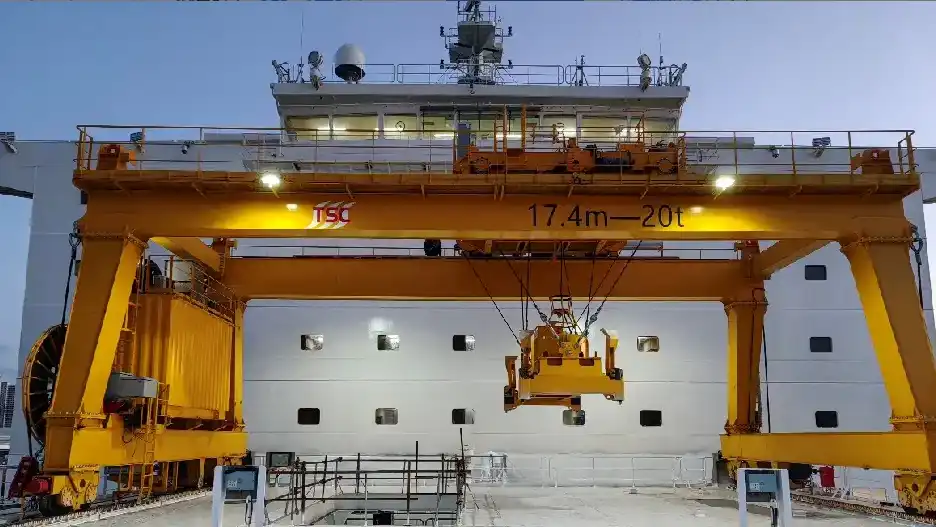
What Makes a Rail Mounted Gantry Crane Different from Other Crane Types
Before getting into the parts, it's helpful to know why project engineers and procurement specialists pick a Rail Mounted Gantry Crane over other options. The most important difference is fixed-path mobility. A gantry crane with rubber tires can move from one aisle to another, but the structure is less rigid and the tires wear out over time, which is an ongoing cost. An overhead bridge crane can only move inside a certain structure. A Rail Mounted Gantry Crane is in the middle. It can move easily along a marked path, keeps its wide, stable span, and runs on electricity from a conductor bar or cable reel system, so it doesn't produce any diesel fumes at all.
Offshore uses like wind turbine installation vessels (WTIVs) and heavy-lift ships don't have to follow this fixed-path rule. It makes things safer. The deck rail layout is planned at the same time as the ship's design. This way, the crane's trip path, load distribution, and structural interface can be checked against the ship's body long before installation starts.
Key Structural Components of Rail Mounted Gantry Cranes
The main parts of every Rail Mounted Gantry Crane are all the same. Each part has its own engineering responsibility, and knowing how they work together helps procurement teams write more specific requirements and more carefully consider source offers.
Main Girder and Portal Legs
The main girder is the main beam that holds the weight of the portal legs together. It has to be able to handle the weight of the hoist assembly itself as well as the forces that come from speeding up and slowing down and, in marine environments, the movement of the vessel. The girder is connected to the train bogies below by portal legs. The shape of these legs—whether they are straight or angled—determines the useful span and headroom over the work area.
Rail System and Bogie Assembly
The rail system is what makes travel smooth and ensures that parts last for a long time for Rail Mounted Gantry Cranes. Tight geometric tolerances must be met when aligning the rails; even a small change in gage speeds up the wear on the wheel flanges and adds lateral forces to the portal structure. The crane's whole body is supported by the bogie system, which has wheels that are usually made of steel with two flanges. These wheels provide side guidance without active turning. When the placement is on a ship, the bogie design also has to account for changes in deck deflection caused by shifting goods and sea conditions.
Trolley, Hoist Mechanism, and Spreader
The trolley moves along the main beam, which sets the hoist horizontally above the load that needs to be lifted. The load is moved up and down by a multi-part reeving system inside the hoist device, which is usually an electric wire-rope hoist for marine gantry uses. Diesel hoists can't change speeds as smoothly as electric drives can, and electric drives need a lot less upkeep over a working life of 20 years or more. The spreader that is connected below the hoist comes into direct contact with the goods. For loads that are in containers or made up of wind components, a custom spreader geometry is often needed to fit the exact sizes of the parts being moved.
Control System and Operator Interface
Modern Rail Mounted Gantry Cranes have variable-frequency drives (VFDs) on all of their motion axes, including the hoist, travel, and traverse axes. This lets them control speed without steps, which is necessary for precise load positioning. The operator can use a standard cab on the entrance frame, a pendant or full cabin station on the deck, or a remote pendant. More and more, modern gantry systems use programmable logic controllers (PLCs) that can be remotely diagnosed. This lets engineers on land check the health of the system and fix problems without sending a worker to the vessel.
Safety and Maintenance Components Critical for Marine Gantry Cranes
A marine Rail Mounted Gantry Crane must have safety architecture; it's not an extra thing that's added on at the last minute. The following safety features come standard with all offshore crane designs that have been properly approved.
A well-designed marine gantry crane has the following main safety features built in:
- Anti-collision sensing: Laser or ultrasonic sensors look for obstacles in the travel path and slow down the vehicle automatically before it hits them. On multi-crane decks, zone management reasoning stops workers from entering shared work areas at the same time.
- Overload protection: Load cells on Rail Mounted Gantry Cranes constantly check the weight that is being moved. When the number gets close to the rated Safe Working Load (SWL), the system sounds a warning. When the overload level is reached, the hoist stops moving automatically.
- Emergency stop and storm anchoring: All operator stations and bogie assemblies have hardwired emergency stop circuits that stop the motion right away. Storm anchor pins automatically fit into deck holes to protect the crane from strong winds when the ship is in port or waiting out bad weather.
- Anemometer integration: Monitoring wind speed feeds directly into the safety relay logic of the crane. When speeds reach operational limits, which are usually around 20 m/s, automatic alarms and motion locks are set off to protect both the structure and the deck crew.
These protections are not extras that can be chosen. Classification groups like DNV, ABS, BV, CCS, and LR require that they be present and check the ship's performance during plant acceptance testing and on-board commissioning. A Rail Mounted Gantry Crane needs to have its running gear and wire ropes oiled, its structural welds checked every so often using NDT techniques, and its safety devices calibrated at times specified in the OEM maintenance manual.
Comparing Rail Mounted Gantry Crane Configurations
Architectural Variants: Portal vs. Semi-Gantry and Power Source Considerations
Rail Mounted Gantry Cranes on rails are not all built the same way. Offshore and heavy-industry buyers can benefit from two main types of architecture.
Full portal versus semi-gantry: A full portal crane has two legs, each on its own rail, that cross the work area. One leg of a semi-gantry is attached to a ground or deck rail, and the other end rides on an elevated runway beam. When there isn't enough room on the deck for two straight rails, a semi-gantry setup works well.
Electric versus diesel power: Electric Rail Mounted Gantry Cranes are the standard for uses that are placed on a vessel. They don't release exhaust gasses in enclosed or partially enclosed deck areas, make the engine simpler, and only use energy when they're moving, which is a big plus when a ship's extra power budget is limited.
Procurement Considerations: Choosing the Right Rail Mounted Gantry Crane Supplier
Beyond Catalogs: Modular Design, Certification, and Delivery Alignment
Choosing a Rail Mounted Gantry Crane for a special ship is not something that can be done from a catalog. The buying cycle usually goes from validating the initial idea to starting the ship, and the supplier's ability to contribute effectively at each stage is what sets capable partners apart from commodity vendors.
The design of a modular power unit makes both the initial installation and long-term maintenance easier. A modularly built crane lets you change individual drive modules without taking out the whole power package. This is helpful on a working vessel where downtime directly affects project income. Also, buyers should make sure that the supplier's factory has the right welding and manufacturing licenses that are recognized by the classification societies listed in the ship's design specification.
It is also very important that the delivery plan match up with the construction schedule. If the Rail Mounted Gantry Crane shows up after the deck rail embedment work is done, it can't be put in place without a lot of expensive extra work. This risk is greatly reduced when suppliers have a history of working together with shipyards and design institutes.
Conclusion
Rail Mounted Gantry Cranes are highly precise machines whose working rests on each part working together, from the main girder's shape to the outline of the bogie wheels and the accuracy of the sensors. For offshore wind and heavy marine projects, where every part has to meet the standards of the classification society and work with the timeline for building the ship, picking the right maker has effects that go far beyond the initial cost of the capital. The most reliable way to ensure on-time delivery and long-term operational confidence is to choose a crane with a modular design, certified welding, full safety architecture, and a supplier that can help with the whole project.
FAQ
1. What factors govern the Safe Working Load of a marine gantry crane?
What is the SWL? It depends on the main girder's structural capacity, the hoist reeving ratio, the train system's wheel load limits, and the dynamic load factors set by the relevant classification society rules. Marine systems take into account how the vessel is moving in ways that plans that are built on land do not.
2. How often should a vessel-mounted rail gantry crane be inspected?
According to the rules of the classification society, polls must be done every year and every five years, there must be a more thorough special survey. The OEM maintenance plan calls for wire rope checks and running gear lubrication to be done at shorter intervals.
3. Can a rail mounted gantry crane be customized for non-standard deck layouts?
Yes, the structural frame of the design lets you change the span, rail gage, journey distance, spreader shape, and control architecture. Before agreeing to a design, reputable makers do a full needs analysis to make sure the Rail Mounted Gantry Crane works with the ship's structural frame and deck load limits.
Partner with CM Energy for Your Next Rail Mounted Gantry Crane Project
CM Energy, which works under the trusted TSC name, offers certified Rail Mounted Gantry Cranes options that are made to fit the needs of offshore and special-purpose boats. With more than 350 deck cranes in use around the world and 159 authorized patents as of August 2024, TSC has a level of engineering depth that is unmatched by commodity suppliers. Get in touch with us at info.cn@cm-energy.com or visit cm-energy.com to talk to a qualified Rail Mounted Gantry Crane manufacturer about your project needs.
References
1. FEM (Fédération Européenne de la Manutention). Rules for the Design of Hoisting Appliances, FEM 1.001. European Materials Handling Federation, 2020.
2. ISO. Cranes — Classification — Part 1: General, ISO 4301-1. International Organization for Standardization, 2016.
3. DNV GL. Rules for Classification of Ships — Lifting Appliances, Part 5 Chapter 7. DNV, 2022.
4. American Bureau of Shipping (ABS). Guide for Certification of Cranes. ABS, 2021.
5. ISO. Cranes — Requirements for Rail Tracks, Wheels, and Rails — Part 1: General, ISO 12488-1. International Organization for Standardization, 2012.
6. Bureau Veritas (BV). Rules for the Classification of Offshore Units — Lifting Appliances, NR 526. Bureau Veritas, 2023.