How does a slew-bearing crane's modular design reduce delivery cycles?
A slew-bearing crane-wire rope luffing crane shortens delivery cycles primarily because its architecture separates into discrete, factory-ready modules — the slew-bearing pedestal, lattice boom, wire rope luffing assembly, and hydraulic/electrical control units. Each module is manufactured and tested independently, so production tracks run in parallel rather than in sequence. TSC, the marine equipment brand of CM Energy, applies this logic across its full range of wire rope luffing cranes, covering fixed platforms, jack-ups, semi-submersibles, drilling vessels, and FPSOs. The result is a measurably shorter lead time without compromising certification or structural integrity.
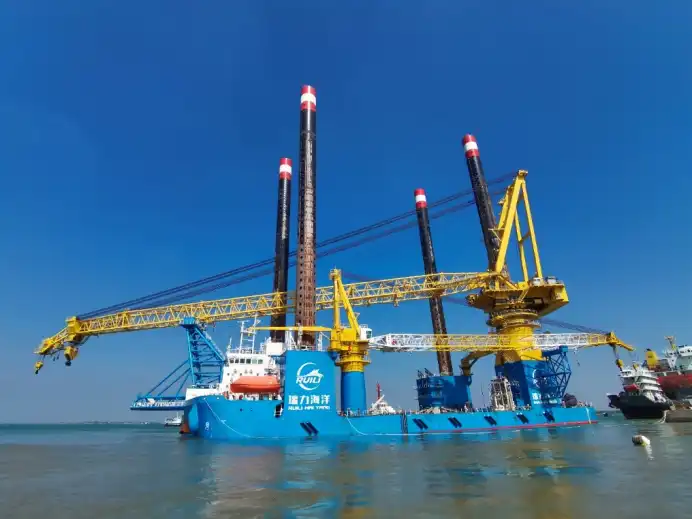
Understanding Slew-Bearing Cranes and Their Modular Design
What Makes a Slew Bearing Different
At the base of a wire rope luffing crane, there is a big slewing ring that is not a normal rolling bearing. It moves mixed axial, radial, and moment loads at the same time and can rotate continuously in a circle 360 degrees. This ring was forge-formed to be resistant to fatigue. It is the actual anchor that holds the spinning superstructure to the deck of the ship. It is easy to use in a modular build strategy because it is a defined, interchangeable part with standard bolt patterns.
How the Wire Rope Luffing System Fits the Modular Concept
Instead of a hydraulic cylinder, a reeved wire rope system in a slew-bearing crane-wire rope luffing crane does the luffing work. Separate parts of the winch drum, rope, sheaves, and lattice boom can be built and tested ahead of time on the shop floor. When the boom sub-assembly gets to the ship, it simply bolts onto a base that is already in place. This greatly reduces the time needed for installation on board.
Standardized Components as the Foundation
Modular design can be used again and again because of standardization. TSC's slew-bearing cranes all have structural links, bolt rings, and hydraulic connection points that are all the same size. Because of this, procurement teams can get certified slewing rings, wire rope spools, and hydraulic pump units from trusted suppliers without having to wait for new drawings every time. This directly cuts down on lead times.
Key Factors Behind Reduced Delivery Cycles Through Modular Design
Parallel Manufacturing Tracks
The fabrication shop can run the pedestal, boom, and machinery house all at the same time because each module of a slew-bearing crane-wire rope luffing crane is separate. According to data from offshore crane projects, making modules in parallel can cut shop time by 20 to 35% compared to building them one at a time. Both TSC's DNV-certified welding plant and BV-certified facility follow this parallel-track method, which directly leads to faster guaranteed delivery dates.
Simplified Component Sourcing
When connections are standardized, the supply chain is stable. Certified companies that make slewing rings, wire rope, and hydraulic parts know exactly what requirements they need to meet. Now, shipyards and platform owners don't have to keep track of separate unique plans for each part. This certainty cuts out weeks of back-and-forth in the buying process, which normally takes one to two months just for asking questions and comparing prices.
Faster Factory Acceptance Testing
Before it is put together for good, a modular slew-bearing crane-wire rope luffing crane is checked at the module level. The slewing drive is checked before the boom is attached, and the luffing winch is tested under load on its own test bench. The system-level factory acceptance test (FAT) goes quickly once all the parts pass their own acceptance checks. TSC's installation process—customer requirements analysis, factory assembly, FAT, product delivery, and on-board installation—shows this step-by-step way of building trust.
Because of these three things acting together, modular wire rope luffing cranes can always reach ships faster than similar combined designs. Procurement managers who keep an eye on project plans will know how useful it is for each stage to come with verified performance data already attached.
Advantages of Slew-Bearing Modular Design in Luffing Cranes
Flexibility Across Vessel Types
One slew-bearing crane-wire rope luffing crane platform can be used for an FPSO, a jack-up rig, or a bulk ship. The only things that need to be changed are the deck contact plate, the length of the boom, and the amount of weight it can lift. The main parts stay the same. Because of this cross-vessel freedom, shipyards that order mixed ships don't have to keep track of different engineering files for each type of vessel.
Maintenance Advantages at Sea
A deck crew can change the luffing wire rope without affecting the slewing drive, and a technician can work on the hydraulic pump circuit without having to pull the boom. This is possible because each subassembly can be reached separately. TSC's centralized greasing system is an add-on that can be used alone or with other parts. It comes in both manual and electric forms. Being able to fix each part separately keeps maintenance costs low and unexpected downtime short, which is very important for operators who have to move goods all the time.
Certification Alignment
A slew-bearing crane-wire rope luffing crane built on a modular platform can get approvals from classification societies like CCS, DNV, ABS, BV, and LR. This is because the structural interfaces and load paths for each module are fully documented. Instead of starting from scratch every time, classification society inspectors look over the same standard plans over and over again for different projects. Because they are already familiar with each other, review cycles are shorter, which saves a lot of time when you look at the whole project plan in months.
When technical managers at shipyards and platform owners talk about their biggest worries, these benefits help: knowing how much maintenance will cost, making cross-project certification work more efficiently, and being able to use a tried-and-true design on a different vessel without having to rebuild the engineering base.
Procurement Insights: Selecting Modular Slew-Bearing Crane Components
Evaluating Supplier Capability
Check to see if the company that makes slew-bearing crane-wire rope luffing crane has active classification society certifications and a certified welding facility before you buy one. These certificates show that the quality system is regularly checked, not just said to be good. TSC has certificates from BV, DNV, ABS, and CCS, and it runs both a DNV-certified and a BV-certified welding plant. These are credentials that can be checked by more than one party, which is important during the vendor approval process.
Assessing Customization Response Time
Different manufacturers differ in how quickly and easily they can set up a crane for a certain ship. The way TSC does things is that they give each question to a separate technical team. This team looks at the vessel plans, deck loads, and operating profiles before coming up with a configuration. One of the main things that slows down marine crane projects is having to make changes to the planning during production. This process keeps those changes to a minimum.
Spare Parts and After-Sales Commitment
A modular system only has full lifecycle value if extra parts can be found. At the time of contract, procurement teams should ask for a spare parts stocking plan and a lead time promise for important things like slewing ring segments, wire rope assemblies, and hydraulic seal kits. TSC's API-2C-certified product line is backed by a global life-cycle service framework through CM Energy. This framework includes expert assistance and spare parts for as long as the crane is in use.
Future Perspectives: Modular Design and the Crane Industry
Digital Manufacturing and Lean Production
The crane industry is moving toward digital manufacturing settings where test reports, module drawings, and records of how to weld are all managed in systems that are linked to each other. This change shortens the time it takes to do paperwork and makes it easier to find things. TSC's integrated electrical control system already records operational data on a regular basis, which helps engineers make decisions about future projects.
Supply Chain Resilience
With modular design, the risk of production is spread out. If one subassembly runs out of a part, the others keep going. Large platform operators who had to deal with major delays during recent global logistics problems are making this supply chain resilience a formal part of the buying process.
Sustainability and Weight Efficiency
Value-engineered flexible designs make things more rigid while also making them lighter. This weight-to-capacity ratio advantage directly leads to cost savings for a slew-bearing crane-wire rope luffing crane used on semi-submersibles or FPSOs that are sensitive to weight. Less structural reinforcement is needed on the vessel deck when the structures are lighter, which lowers both the cost of installation and the total carbon load of the project.
Conclusion
By separating manufacturing, testing, and approval into independent, manageable tracks, modular design shortens the time it takes to deliver a slew-bearing crane-wire rope luffing crane. The slewing ring pedestal, the wire rope luffing assembly, and the control systems all move along at their own pace and are fully checked before they are put together for the last time. This idea is used by TSC's CM Energy in all of their wire rope luffing cranes that are approved by CCS, DNV, ABS, BV, and LR.
FAQ
1. How long is the typical delivery cycle for a modular wire rope luffing crane?
Delivery times depend on the capability and setup. For standard setups in TSC's known series, it usually takes between three and six months from the time the contract is signed until the product is delivered. This window may be longer if custom setups are made for certain types of vessels. This guess stays the same thanks to modular production tracks, which don't make modules wait for others to finish before they can start.
2. Does modular design affect structural integrity?
No, every part of a slew-bearing crane-wire rope luffing crane is designed to work with loads in the same way as a single piece of material. Drawings approved by the classification society show all the details of the module joints, and connection welds are put through non-destructive testing (NDT), which includes ultrasonic and magnetic particle inspection.
3. What classification societies cover TSC's wire rope luffing cranes?
The slew-bearing crane-wire rope luffing crane range from TSC has been approved by CCS, DNV, ABS, BV, and LR. It also works with the API-2C license. During the inquiry stage, buyers can ask for certain documents from the society.
4. Can an existing vessel be retrofitted with a modular crane?
Yes, as the first step in the installation process, TSC does a customer needs analysis. This includes looking at the current deck construction and pedestal connections. Because modular pedestal designs can be used with different deck load setups, they make retrofit projects easier to handle than options with combined designs.
Contact CM Energy for Your Next Slew-Bearing Crane Project
The TSC brand from CM Energy has a full range of slew-bearing crane-wire rope luffing crane options that are approved by major classification societies and come with global service after the sale. Whether you need a standard series unit or a configuration that fits a specific vessel, our technical team is ready to look at your needs and help you choose the best crane for your project's budget and schedule. To get in touch with a slew-bearing crane-wire rope luffing crane maker who can get the job done on time, email us at info.cn@cm-energy.com or go to cm-energy.com.
References
1. American Petroleum Institute. API Specification 2C: Offshore Pedestal-Mounted Cranes. 7th ed. API Publishing Services, 2012.
2. Fédération Européenne de la Manutention (FEM). FEM 1.001: Rules for the Design of Hoisting Appliances. 3rd ed. FEM, 1998.
3. International Organization for Standardization. ISO 4309: Cranes — Wire Ropes — Care and Maintenance, Inspection and Discard. ISO, 2017.
4. Det Norske Veritas. DNV-ST-0378: Standard for Offshore and Platform Lifting Appliances. DNV, 2021.
5. Harris, Frank, and McCaffer, Ronald. Modern Construction Management. 7th ed. Wiley-Blackwell, 2013.
6. Bralla, James G. Design for Manufacturability Handbook. 2nd ed. McGraw-Hill, 1998.
