Desilter Cyclone Guide for Optimal Drilling Fluid Cleaning
A desilter cyclone is one of the most important tools in any solids control system. It removes fine drill solids — typically in the 20 to 44 micron range — from drilling fluid using centrifugal force, allowing clean mud to return to the active system. When your drilling fluid stays clean, you protect your drill string, reduce mud replacement costs, and keep the entire operation running efficiently. This guide walks procurement professionals and mud engineers through everything they need to know about desilter cyclone selection, maintenance, and what to look for when sourcing equipment.
Understanding Desilter Cyclones: Principles and Functions
How Centrifugal Separation Works?
A desilter cyclone spins the drilling fluid that comes in very fast. Heavy solid particles are pushed outward by centrifugal force and hit the wall of the cyclone. They then travel downward and leave through the underflow opening. The cleaner fluid goes up through the vortex finder and back into the mud system. The cyclone is a reliable link in the solids control chain because this process goes on all the time and there are no moving parts.
Key Design Elements That Affect Performance
What size particles the cyclone can sort depend on how big its body is. The smaller diameter cyclones used in desilter systems are better at going after finer particles than the bigger cones used in desander units. Cut point and throughput are all affected by the cone angle, the width of the vortex finder, and the size of the underflow nozzle. Before you buy, you must make sure that these parameters are correct for the weight and flow rate of your mud.
Why Fine Solids Removal Matters?
Between 20 and 44 microns, drill solids are small enough to get through shale shaker screens but big enough to do real harm. They make the mud thicker, speed up the wear on the pump and bit, and force you to lessen or throw away expensive mud. A desilter cyclone of the right size will remove these particles before they build up, protecting equipment further down the line and keeping the qualities of your mud within the range allowed.
Comparing Desilter Cyclones with Alternative Solids Control Equipment
Where Desilter Cyclones Fit in the Solids Control Sequence?
It takes time for solids control to work. Shale shakers start by moving the biggest pieces around. The next step is desanders, which go after the medium-range solids. The smaller part is then taken away by desilter cyclones. At the end of the chain, centrifuges deal with very small colloidal solids. All the equipment has its own job to do, and skipping a step makes the next unit work with more weight than it was made to handle.
Desilter Cyclones vs. Shale Shakers
Shale shakers are motorized screens that can handle large amounts of coarse sorting. Particles smaller than 74 microns cannot be reliably caught by them. That is where the shaker leaves off. The desilter cyclone then goes after the fine solids that get through the screen cloth. They work well together to make a first-pass and second-pass cleaning system that works.
Mud Cleaners as an Integrated Option
A mud cleaner has a desilter cyclone unit and a fine-mesh shaker screen placed right below it. The cyclones' underflow falls on the screen, which collects grains but lets liquid mud and barite pass through and go back into the system. In weighted mud, where you cannot afford to discard the expensive weighting material along with the drill solids, this method works well.
CM Energy HMC Mud Cleaner: A Practical Desilter Cyclone Solution
What the HMC Mud Cleaner Does?
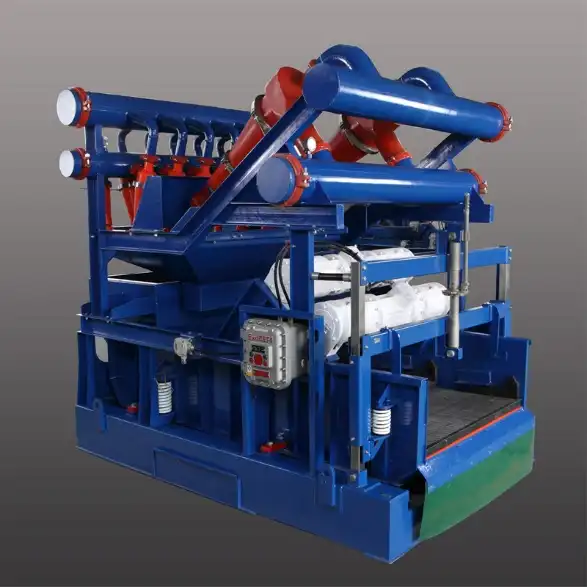
The TSC brand of the CM Energy HMC Mud Cleaner has a desander assembly, a desilter cyclone assembly, and a shale shaker all built into one small machine. The desander works with particles that are 44 to 74 microns, and the desilter assembly works with particles that are 20 to 44 microns. The built-in shale shaker gets drilling fluid and barite out of the underflow and puts useful fluid back into the active system. Recovery efficiency and cyclone durability are the two main worries of procurement teams, and this design directly addresses both.
Flexible Configuration Options
The HMC Mud Cleaner can be used in four different ways. These are the available combinations:
- Desander and shale shaker — good for loading lighter solids where separating fine particles is not the main goal
- Desilter cyclone and shale shaker — designed to remove fine solids while recovering fluids through the shaker deck
- Desander, desilter cyclone, and shale shaker combined — the full-stage setup for tough drilling conditions
- Shale shaker only — when the cyclone parts are not needed for a certain type of rock or fluid
Because it is so adaptable, this unit can work with different well sections, mud systems, and operating goals without having to buy new tools.
Engineering Features Worth Noting
TSC made the HMC with features that have been tried in the field and have been shown to make operations easier. Since the hydrocyclones' underflow nozzles can be switched out, the user can change the nozzles without having to shut down the machine when the discharge pattern changes, such as when it becomes too wet or too dry. The deck angle can be changed while the unit is running, so the crew can fine-tune separation without having to stop work. The slightly cylinder-shaped hill deck design keeps screen tension steady, which improves separation quality. The pre-tensioned plane screen (PTS) spreads fluid evenly across the deck. Solids cannot get past the screen and contaminate the tank below because the structure is completely sealed.
For the desilter cyclone parts, you can choose from polyurethane, iron-shell polyurethane, and ceramic cyclone materials. When planning for new parts over the life of the tools, it is important to know that each material has a different cost-to-wear-resistance ratio. These engineering choices fix common problems like cone wear, screen blinding, and fluid leakage at the design level.
Procurement and Purchasing Guide for Desilter Cyclones
Evaluating Suppliers and OEMs
As important as the unit price is when looking for a desilter cyclone system, the track record of the seller and help after the sale are also very important. CM Energy and its TSC brand have a global service network with local help in places like the Middle East, North America, and Southeast Asia. The company offers technical support 24 hours a day, seven days a week, and will make drawings and a bill of materials based on your technical agreement. This dedication reduces the chance of long downtimes when extra parts are needed.
Factors That Drive Procurement Decisions
When oil services companies choose a desilter cyclone seller, these are the things that procurement managers usually look at:
- The processing capacity is matched to the movement rate of the rig
- Cyclone cone material and replaceability — wear parts must be close by or can be ordered quickly
- Integration with existing shale shakers and centrifuges on the mud system
- Delivery schedule based on project start dates
- A chain of suppliers for spare parts for nozzles, screens, and cyclone bodies
If you look at all of these things before you sign a purchase order, you will not have any expensive surprises during the first maintenance cycle.
Customization for New Builds and Retrofits
CM Energy can help with engineering for both building new rigs and making existing ones better. The HMC Mud Cleaner has a small footprint, so it can be added to existing mud tanks without having to make major structural changes. You can talk to the CM Energy technical team directly to get custom designs based on mud weight ranges, flow rates, or room limitations.
Maintenance and Troubleshooting for Desilter Cyclone Systems
Routine Inspection Points
Regular checks of the underflow nozzles, desilter cyclone inlet manifold, and overflow pipes are needed for the system to work well. Wear on the nozzle changes the flow pattern, which has a direct effect on how well the separation works. Check the wear on the tip after each set of wells or at regular times set by the abrasive formation data.
Common Performance Problems and Fixes
If solids come out of the underflow nozzle in the form of a thick, rope-like stream instead of a spray cone, this means that the nozzle is either too small or partly blocked. When you replace the nozzle with one of the right sizes, the separation works again. Check the input pressure and make sure the cyclone body does not have any cracks or wear-throughs if the overflow is cloudy and objects can be seen.
Extending Equipment Life
Using the right cyclone cone material for your rough conditions is the most important thing you can do to lower the number of replacements and the total cost of ownership. In very rough environments, ceramic cones last longer. In moderate conditions, polyurethane cones are a good value for the money. Using the right material for the job keeps the cost of extra parts low over the course of the project.
Conclusion
A desilter cyclone is a useful and inexpensive way to keep the quality of the drilling fluid consistent throughout the well. It lowers the cost of mud, protects equipment further down the line, and keeps the solids control system working within its design limits when the right cone material, flow capacity, and integration design are chosen. With the TSC brand's deep technical knowledge and global service reach, the CM Energy HMC Mud Cleaner is a well-designed choice for workers who want dependability without too much complexity. If you are looking at solids control tools for a new project or an update to an existing system, choosing the right desilter cyclone will pay for itself many times over.
FAQ
1. What particle size does a desilter cyclone target?
A desilter cyclone is made to get rid of particles that are usually between 20 and 44 microns in size. This is the size range that can get through shale shaker screens, but it is still big enough to change the features of mud if it stays in the active system.
2. How do I choose between polyurethane and ceramic cyclone cones?
Which one to use depends on how rough the drill solids are. Ceramic cones last longer and can handle particles that are harder and rougher. Polyurethane cones are less expensive at first and work well in moderately rough conditions. Before you choose cone material, look over your formation data.
3. How often should I replace the underflow nozzles?
How often nozzles need to be replaced depends on how rough the rock is and how much flow there is. If the discharge pattern changes from a spray cone to a rope, that is the best sign that the field needs to be replaced.
4. Can the HMC Mud Cleaner operate as a standalone shale shaker?
Yes. The HMC Mud Cleaner can be set up in four different ways, including as a shale shaker that does not need the cyclone sections.
5. Does CM Energy provide spare parts and technical support?
Through its global service network, which includes key areas like the Middle East, North America, and Southeast Asia, CM Energy offers expert help and spare parts 24 hours a day, seven days a week.
Partner with CM Energy for Your Next Desilter Cyclone Purchase
There is a tested line of desilter cyclone solutions from CM Energy and the TSC brand, such as the HMC Mud Cleaner, that is made to work well in tough drilling environments. CM Energy is a reliable company that can help with both new builds and system upgrades, offering localized service networks, personalized engineering support, and expert help after the sale. Get in touch with our team right away to talk about your solids control needs and get a setup that works for your project. Reach us at info.cn@cm-energy.com or visit cm-energy.com.
References
1. Bourgoyne, A. T., Millheim, K. K., Chenevert, M. E., & Young, F. S. — Applied Drilling Engineering (SPE Textbook Series, 1986)
2. Drilling Engineering Association — Solids Control in Drilling Fluids (DEA Report, 1993)
3. American Petroleum Institute — API RP 13C: Recommended Practice on Drilling Fluids Processing Systems Evaluation (API, 2010)
4. Caenn, R., Darley, H. C. H., & Gray, G. R. — Composition and Properties of Drilling and Completion Fluids (Gulf Professional Publishing, 2011)
5. Society of Petroleum Engineers — SPE 56558: Optimization of Solids Control Equipment in Drilling Operations (SPE Journal, 1999)
6. World Oil — Advances in Hydrocyclone Technology for Drilling fluid Solids Removal (World Oil Magazine, 2018)